
Tendai Huchu, one of Zimbabwe's celebrated authors, is leading a group of fellow authors on a writers retreat in Nyanga

Nyanga Mountain, highest mountain in Zimbabwe
(Photo: Manica Post)


I pointed out that the majority of the ordinary women whose story Nervous Conditions was telling would not be able to buy, read and understand Nervous Conditions in English, because of their literacy levels. I thought perhaps I could try to translate the book into Shona as a way of repatriating and decolonising the story. " - Ignatius Mabasa
READ FULL INTERVIEW HERE
Beaven Tapureta - for Winzim Online

Front cover of Between Starshine and Clay

As
multi-layered as the book is, it is however the author’s continued search for
what home really means to the Africans in Africa and in the diaspora.
Between Starshine and Clay’s portrayal of these much sought-after, high-profile people carries its own historical exclusivity enhanced by the author’s patient observation and research, resulting in these detailed, enlightening conversations.
Poet
Claudia Rankine, documentary film-maker Xoliswa Sithole, Nobel Laureates Toni
Morrison and Wole Soyinka, feature in the first section ‘The Creators’ while
the second section, tagged ‘The Curators’, features historian Henry Louis Gates, Jr, publisher Margaret
Busby, Mrs Willard Harris, and actor and playwright Anna Deavere. They are ‘the
curators’ who somehow have been on a mission “to find and gather our stories
and histories, record them and make them accessible”. These individuals have, in their different
capacities, archived and told the usually under-told story of Africa and its
diaspora, of women and children.
The
third and last section, ‘The Changemakers’, features Michelle Obama who was the
first Black American First Lady and an author too, parliamentarian Lord Michael
Hastings, who has done great work in the United Kingdom to address the plight
of the poor, the disadvantaged, and those in prison, civil rights activist
Pastor Evan Mawarire who became a voice for the voiceless Zimbabweans during
the late former president Robert Mugabe’s reign, and US Senator Cory Booker, a
champion of equality and justice.
Manyika’s
detailed personal story ‘Notes of a Native Daughter’ which follows the insightful Foreword by Bernardine
Evaristo makes a testament of its own,
an exploration of what being an African
means when looked from different
windows.
Having
had the unusual opportunity to talk to her and review her books in the past few
years, I am sure others agree she is a very passionate author devoted to probing
the multi-dimensional meaning of home especially with regard to those of
African descent wherever they may be.
The
twelve greats in the new book have their life experiences, ideas and
convictions, whether political or literary or artistic, captured with
liveliness which has now become the mark of the author.
In
my past review of her debut novel In-Dependence (Weaver Press, 2014), I
noted how the main character Tayo, a university African student in Britain, falls in love and subsequently falls into a different kind of ‘home’ where he learns to
explore his emotions more deeply. The
aspect of ‘home’ is very interesting. Reading Manyika’s non-fiction book is the
same as viewing different dimensions which the meaning of ‘home’ has in the
minds of black people scattered across the world. The magnitude of her inquiry
into how it feels to be black or of African descent in a different society is
heart-deep. No wonder Between Starshine
and Clay starts out with this Hurston quote:
‘Sometimes, I feel
discriminated against, but it does not make me
angry. It merely
astonishes me. How can any deny themselves the
pleasure of my company?
It’s beyond me.’
–
Zora Neale Hurston, How it Feels to be
Colored Me
Some
of the conversations are sub-divided into two parts, ‘On Meeting’ and ‘In
Conversation’, others are singularly ‘In Conversation’ which are one-on-one
interviews but still one gets enamoured by the openness, depth of emotion, the
knowledge exchange between the interviewer and interviewee. The ‘On Meeting’
pieces show us Manyika at pleasure to observe, relate and describe outdoor and
indoor particulars of her subject.
In
fact, she acknowledges, “This book has emerged from multiple interactions with
its twelve main subjects. Some pieces are essays, others are conversations. ‘On
Meetings’ grew from encounters with the person featured, and their works, over
time. ‘In Conversations’, as captured here, represent a single conversation,
lightly edited for flow – a snapshot, in most cases, of many more conversations
we have had over the years.”
With
the ‘On Meeting’ essays, Manyika walks you into Toni Morrison’s house and into
the great writer’s restroom where there are writers’ photos and literary
letters pasted on the walls, she lets you hear the humor echoing from Toni’s
study and you wish you could stay just a few more hours in the house. Through
her expert descriptive writing, she takes you closer to the endeared Obamas,
into the People’s House (White House), to the San Jose’s SAP arena where
Michelle Obama and Michele Norris are having an illuminating open talk. Oh I am
one of those who did not know that Michelle Obama is the author of the family
memoir Becoming which Manyika also analyzes.
And if you want more, Manyika is with you on the pages when she gets to a book
launch inside the Paul Webley Wing of London University’s School of Oriental
Studies (SOAS) where you meet various great and inspiring women, including
Margaret Busby, to whose house in Clerkenwell you are later transported. Margaret
is the celebrated ‘doyenne of Black British publishing’.
I
once described Manyika’s second novel Like
A Mule Bringing Ice Cream To The Sun in my review as ‘…a courageous investigation
into the joys and vagaries of age, and at the same time, a subtle unveiling of
the racial battle running beneath multi-cultural American society’.
Thus
the three books carry the author’s tireless clamour for a free and happy world
in which people are not judged on the basis of skin colour, a world in which
different political views are permitted, a world free from poverty and hunger.
This may sound too generalised an overall embrace of the three books but it
serves well to understand the author.
Manyika’s
latest book no doubt bursts from this deep source inside her, a powerful spring
that never runs dry, always giving out the divine water, the words for a global
garden of togetherness. To celebrate the courage and achievement of black
people in the global village is to celebrate universal legacy. However, the
conversations in the book turn personal each time the author puts across a
question about race or being black. This is a very sensitive issue.
In
her recent interview with Open Country Magazine, she describes her book Between
Starshine and Clay as ‘…conversations that speak to what we endlessly
aspire or strive towards — the idea of progress, of a fairer more equitable
society, of a better world for future generations. They are conversations that
touch on stories that are a reflection of all of us (any of us) and speak to
certain truths and universal human experiences.’
In
the book, through attentive description, some things speak for themselves. For
Toni (she told Manyika she prefers ‘Toni’), Africa lives in her house. Her
‘home’s furnishings… with accents from Africa’ and ‘a small Shona sculpture’
tell of the pride she takes in being African (American). Manyika rightfully
writes about the house that it embodies ‘Harare, Lagos, Accra, Kingston’. Truly,
a home of cultural pride.
Mario
Kaiser, who is accompanying Manyika when she meets Toni Morrison, asks: …Why
can skin color still make or break people in this country?
In
Kaiser’s question, ‘this country’ refers to America. And Toni’s response is
rooted in history. She openly denounces white-skin supremacy or such labels as
‘I am a white Swede’ in America.
‘On
Meeting’ Michelle Obama from a distance, Manyika is curious to ask the former
First Lady certain questions she had always wanted to ask, including “Did the
White House felt like a home, a fortress, or a prison?”
Home,
what did Manyika want to know?
However,
she never gets to ask this question when the two finally meet.
Michael Hastings, parliamentarian and also a
wide reader with pan-African roots
stretching from India to in Angola. He now lives in the UK. He
talks about ‘changing the narrative’ when he is asked what he thinks about the
African Diaspora.
Hastings
understanding is that Africans in the Diaspora must not be viewed simply as
just “great cultural bearers of heritage from another continent, but actually
as phenomenally intelligent academics, economists, medical experts, people who
are innovators, technicians, creators, drivers of wealth, supporters of
community and hospital workers.” He calls for “the wider world out there to
give us the time and the dignity to be heard.”
It
all echoes the fact that the African Diaspora is no stranger in the world but a
human community deserving respect. And respect is what Hastings wishes could be
given to any member of society without the biases of gender, race, etc.
At
some point in time, when home becomes a place of strife, not actually of racial
disaster but a place of extreme economic and political disaster, the patriot feels
the need for change. Manyika vividly
captures the evening when in his church office, weighed down by the prevailing
economic stress, Pastor Evan Mawarire started what would become the #ThisFlag
movement that inspired positive action and touched many a heart in Zimbabwe and
the world.
Manyika’s
‘On Meeting’ with Mawarire outlines how much this change-maker suffered – the
arrests, the imprisonment, the threats – but also she celebrates the courage he
had/has in his fight for a better
Zimbabwe, a better home.
Apart
from clarifying his friendship with fellow Nobel Laureate Toni Morrison and
many other issues in his conversation with Manyika, the guru Wole Soyinka
passionately views Africa as “not just a continent”. Soyinka displays his deep love
for African culture, and this love led him to be part of a team that travelled
to Brazil and London in a bid to recover a piece of art ‘stolen’ by the
colonialists from a Nigerian museum.
In
the conversations with Soyinka and Mawarire, albeit these two having different
backgrounds, there is a shared lesson that Africa should promptly recover the
missing dimensions which once identified it originally as a thriving, peaceful
continent, that Africans must rise to defend the motherland against looters of
its cultural art and freedom.
Soyinka
says, “I grew up with this history. These are the precipitates of a people’s
spirituality. In the process, that meant that even the spiritual network that
bound the Black people together was just being shredded to pieces. So, this was
beyond just a piece of work to be admired. This piece of work, incidentally,
was the image on one of the Nigerian stamps for a long while. And to see this
being advertised around the whole world as what the African genius had
produced, it hurt. I’m explaining why there was no hesitation about my going on
that recovery mission.”
Claudia
Rankine, a multi-award winning poet and playwright also talks about anti-blackness,
about the right to vote as an American citizen. Rankine says among her influences
is Fanon: “Fanon…for me, being maybe the most crucial in the way his work
addresses the psychological ramifications of anti-Blackness within a society.”
Award-winning
film-maker Xoliswa Sithole’s story of the difficulties faced by women in the
film industry echo those of Zimbabwean film-maker and writer Tsitsi Dangarembga
and others. In the conversation, Sithole says she loves making documentaries
that tell the untold stories of women and children especially, as Manyika puts
it, “in the context of pandemics, war and poverty”.
Yet,
much to Sithole’s disappointment, funding is difficult to source because she is
a woman. She outlines the need to fight against the “erasure of women out of
history”.
The
closing chapter ‘A White Continent’ is Manyika’s recollection of her exciting,
informative and yet a little dangerous expedition to Antarctica’s South Pole in
January 2022. However, through this journey she makes new discoveries which she
shares in this chapter, like climate change, women explorers, and interestingly
about how thoughts of skin colour diminish in Antarctica, an extremely cold
continent almost entirely below the Antarctic Circle; covered by an ice cap up
to 13,000 feet deep. To survive the cold, you have to be dressed up in layers
and layers of clothing.
“One
of the things about being bundled up in layers of polar clothing and gear is
that when outside you rarely see a person’s skin color. The body is so covered
up it’s hard to recognize who’s who. All that is clear is that a figure is
human – not Black, not white, just human.”
All
the black people featured in Between
Starshine and Clay are heroes and heroines whose experiences have important
lessons for the world. They are but only a segment and Manyika admits that
“from such a vast continent and its diaspora, there are many inspiring voices
that could be included in a book like this”.
This
book is of great relevance to everyone, for it carries real-life stories from
the African diaspora, stories which the media had seemingly been parsimonious
about. It is a classic that will break boundaries.
Winzim Online

Every year October 10 is observed as World Mental Health Day which aims ‘to raise awareness of mental health issues around the world and to mobilize efforts in support of mental health’. This year, the theme was ‘Mental Health is a Universal Human Right’. As the world recognized this day through various events, World Health Organization’s 2022 World Mental Health Report rebounds with a sad note that mental health conditions are increasing worldwide.
The
pressure of daily modern life has plunged men, women, teenagers and youths,
into a dungeon of depression, drug abuse, suicide, anxiety, in fact all the
filthiness usurping the human mind.
There’s hardly a family that has not been affected by any of the mental
health issues topping the agendas at world medical and health conferences. Governments
and NGOs have woken up to the call of addressing mental health in an attempt to
save the future generations.
Dictionaries
define mental health as a ‘psychological state of someone who is functioning at
a satisfactory level of emotional and behavioral adjustment’ and mental
disorder as ‘a psychological disorder of thought or emotion.’
Mental
disorder is a more neutral term than mental illness. There are many a different
meaning and cause, some rational and others irrational, attached to the words
‘mental health’ or ‘mental disorder’ or ‘mental illness’.
Psychologists
or psychiatrists have their take while personal development coaches,
traditionalists (spiritual and cultural),
and others, have their own viewpoints (and biases) too.
Yet
even as threatening as it is, mental health awareness can be raised through the
literary arts also; hence we have poets or writers vigorously writing about the
subject.
Seven Zimbabwean poets concerned with the rising
statistics of problems to do with mental health came together and hatched ten
poems each to produce a wonderful anthology called Not Forgotten: Remembered with Love (2023, Ruvarashe Creative
Writes).
The anthology
editor, Morset Billie, notes that the poets’ aim ‘to dispel the stigma
associated with mental health challenges….’
If you
read the anthology quietly, listening with mind (not ears) to the voices of the
personae, you realize mental health is not something to take for granted. You
witness a sad realm of individuals burdened by pain, suicide ideation, regret,
self-pity, drug addiction, guilt and loneliness.
It is a relief that the
book is not totally sad but it comforts. You rejoice when victims become
victors. The poems are a conglomeration of survivors’ voices and the witnesses’
voices, a poetic choir of hope.
There
is a time when even the sufferer discovers the root cause of his/her suffering as
depicted in Ruth Mutana’s poems. A homeless grown man in ‘An Image of a Street
Man’ sees his childhood reflected in a nearby poor, wailing boy who’s being ignored
by his busy parents. Like the boy, the
man ‘always waited to be loved and cared for…’ but he was cast out of home
because he ‘started talking and laughing’ to himself’.
In
marriage, some partners scarcely accept their weaknesses; the result is marital
friction as in another of Mutana’s poems ‘The Gas Lighter’. The woman cries:
…When I expressed my feelings
honestly
He called me a liar
When I explained his
shortcomings to me
He called me delusional
Until I began to question my
sanity
Courage
E Karuma pleads with the busy world, especially family members, to give an ear to
those trapped in drugs or suicide thoughts, those crying out for help. His
poems often address the brother, sister, mother. For example, in ‘Welcome to my
World’ a voice pleads:
Why won’t you listen?
I called last week; you were
busy
At that time, I went searching
for death
In the
poem ‘Mother, I am Scared’, you wish you could attend to the voice of possibly
a youth who is under the influence of drugs, alone in his room seeing awkward
visions, calling out to his mother who is not there for him.
Tabeth
Manyonga, the anthology publisher, also contributed pieces that largely touch
on the worker’s plight. She shows how the workplace can inflict worst wounds in
the mind. When one fails to live up to the bosses’ expectations, is segregated
and gets treated like a slave, the mind is easily pressured to give in to
depression.
For example,
the persona is her poem ‘The Stairs’ has feelings of regret and after failing to
be like the others, says:
I lost my sanity trying to keep
up
The
poets Onward Mutapurwa and Ruvimbo Martha Jeche are voices of comfort, echoing
the anthology’s mantra that ‘it’s ok not to be okay’.
It is
mentioned in his brief biography that 23-year old poet Alison Tinashe Muzite is
‘an author also notable for distinctively writing, drawing and painting using
both hands simultaneously’.
When
reading his poems, especially the first two titled ‘Alone’ and ‘Lonely’ set
side by side, something suspiciously exciting moves between your eyes: the
poems are like a painter’s brief, quick strokes made by both hands at the same
time, yet capturing different meanings.
Tanaka
Mercy Murwira, an aspiring poet, also echoes the psychological wailings of
people in different storms of life.
Not Forgotten
carries poems in simple but inherently soulful language; that is the good of
it. It’s a timeless, helpful book. Reading Not
Forgotten is therapeutic. This anthology surely must be made part of rehabilitation
or treatment programs for people with mental health problems.
***
Winzim Online


Guests
entering the ICMF board room are welcomed by cool Afrojazz music oozing from a
corner. The sound is not intrusive. Victor Masara, an Afrofusion musical
artist, performs with gift, performs with passion, and entertains them. Near a
window is an eye-catching large table upon which copies of Corridors of Leadership stand or lie around a white decorated birthday
cake.
Among
the arriving guests is the guest speaker, Noah Mangwarara, an accomplished
motivational author and coach. The panellists Sympathy Sibanda, Tabeth Manyonga,
Geraldine Eve, and Beaven Tapureta, have arrived, together with the author who
is in the company of his supportive parents and other relatives.
In a
moment, the MC walks to the front, and Masara music fades into silence. The introductions,
followed by panel discussion and speeches begin.
The
panel discussion dissects the book from exciting different perspectives. Passages
from Corridors of Leadership are brought up to justify a point, a comment or
criticism.
Afterwards,
guest speaker Mangwarara lays out in alphabetical order first letters of what
he says are the six major themes Mutize tackles in his book – Action, Believe
(self-belief), Create ( a legacy), Develop (other leaders), Excellency and
Focus. He goes on to explicate each of the themes.
Mangwarara
emphasizes everyone is a leader but the choices people make can reflect whether
they are effective or ineffective leaders.
He
applauds Mutize’s approach in the book, especially his use of the parable style
such as the Parable of the Pencil, lessons drawn from great world leaders,
Bible verses, references to authors who have tackled same subject, and stories
from his everyday life experiences. All these strategies, Mangwarara says, urge
the reader to continue reading, inspired.
The
launch is double-fold, being also a belated celebration of the author’s
birthday which occurs on April 14.
Mallvine Mutize is an award-wining certified Life Coach, mentor, a leadership practitioner and author of Stepping Stones to Self-Discovery and Self Help to Growth. He also co-authored Growth Recipe. He is the director of The Vine Consultancy whose mandate is to develop children and young people, build and strengthen teams for better performance. Mutize sits on several boards of youth-based organizations.

Mallvine T Mutize

***
Winzim Online

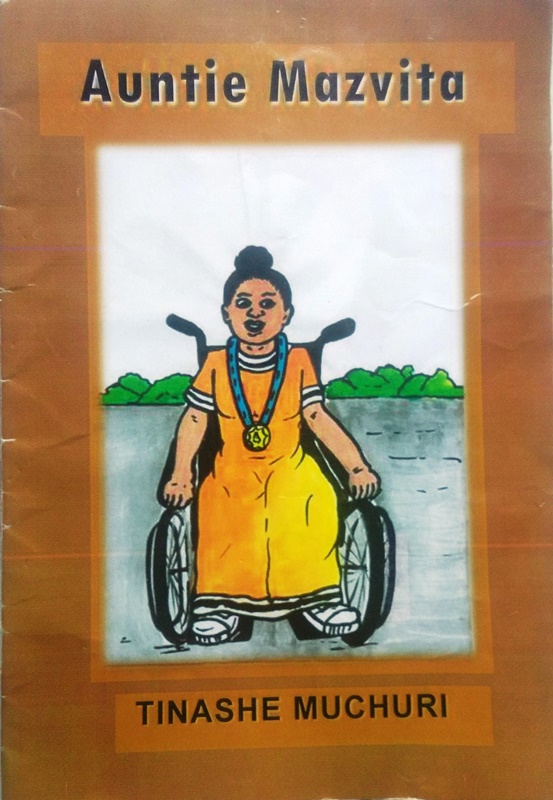 Tinashe
Muchuri’s Auntie Mazvita (2021,
Essential Books Publishing Company), a children’s book shortlisted for the NAMA
award last year, offers children the cultural wisdom necessary to uproot moral
poverty reeking in modern day society, African society in particular.
Tinashe
Muchuri’s Auntie Mazvita (2021,
Essential Books Publishing Company), a children’s book shortlisted for the NAMA
award last year, offers children the cultural wisdom necessary to uproot moral
poverty reeking in modern day society, African society in particular.
Before
ICT somehow chopped away the role of the traditional aunt, an adviser and
storyteller, the children were protected and the home was their first school.
Parents, aunts and uncles, were the basic teachers who, through storytelling, they
would mentor a child to understand the spirit of Ubuntu.
Nowadays,
the children hardly sit around the fire to listen to grandma or auntie who
usually has lots of exciting stories and games. Actually, there are no aunts to
make them laugh as tsuro makes a fool
of gudo, to make them ask questions
to understand the moral lesson.
Books
like Auntie Mazvita will always be
important in capturing the kids young so that they grow up understanding life
and the Ubuntu spirit.
Auntie Mazvita is not
an action or fictional narration but a real-life inspirational story told by
the storyteller Auntie Mazvita herself. She tells the story of her life and her
role in the village. She reminds the children and adults alike of how
storytellers were highly regarded because of their gift of knowledge.
‘I was
taught that a storyteller builds the future. It is through the stories told to
children that a strong foundation is laid. Without proper stories, the future
is dull,” she says in the book.
The colour
illustrations add some liveliness.
Auntie
Mazvita is at ease with the inquisitive boys and girls; she shares with them her
knowledge through song and dance. Yet she does not forget the realities of
social evils haunting the children; such evil as child abuse, hence she
protects the kids by educating them.
Although
she is wheel-chair bound because of polio, she is an achiever, a Paralympic
champion. After reading this book, children will love to associate with fellow
pupils or friends who live with disability. They will understand that
disability is not witchcraft – or some superstitious punishment, but it is usually
a medical condition or a result of accident.

‘I am
not a charity case or a special one. I work for myself. Telling stories is a
career. I am working,” she tells the children. Her independence inspires the
children to aim higher despite challenges life may present.
As a
counsellor, she has earned the confidence of villagers who are having marital
problems. It means she is not there for the kids only, but for the whole
village.
In this
little but sagacious book, Tinashe Muchuri proves that we cannot do without the
storyteller. Muchuri is an award-winning journalist, writer, poet, translator, and
actor. He is the author of the Shona novel Chibarabada
(2015, Bhabhu Books)
***
